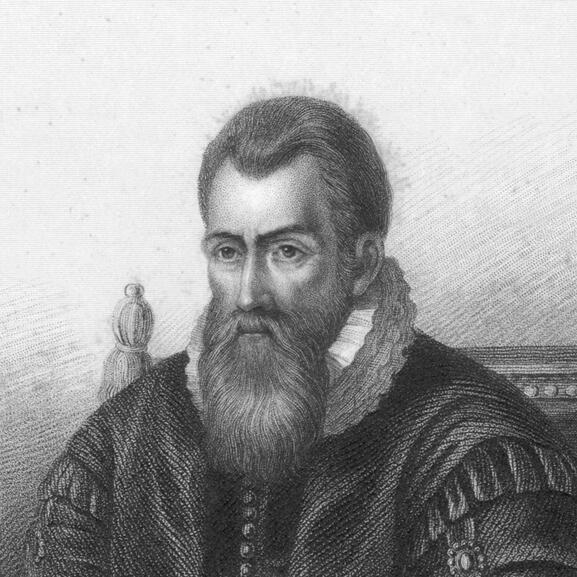
John Napier of Merchiston
( 1 February 1550 – 4 April 1617 )
The Advent of the Logarithmic Scale
Fast Info
Not widely known however very influential in mathematics
Made life easier for all future mathematicians with his inventions
Logarithm
Decimal Notation
Despite being a full-time mathematician, he also have a dark side like Newton
He was into the occult and tried to dabbled in necromancy
More contents
by Sunny Y. Nguyen
John Napier of Merchiston
John Napier of Merchiston. ( 1 February 1550 – 4 April 1617), nicknamed Marvellous Merchiston, was a Scottish landowner known as a mathematician, physicist, and astronomer. He was the 8th Laird of Merchiston. His Latinized name was Ioannes Neper.
John Napier is best known as the discoverer of logarithms. He also invented the so-called "Napier's bones" and made common the use of the decimal point in arithmetic and mathematics.
Napier's birthplace, Merchiston Tower in Edinburgh, is now part of the facilities of Edinburgh Napier University. There is a memorial to him at St Cuthbert's at the west side of Edinburgh.

Life and Education
Napier's father was Sir Archibald Napier of Merchiston Castle, and his mother was Janet Bothwell, daughter of the politician and judge Francis Bothwell,[3] and a sister of Adam Bothwell who became the Bishop of Orkney. Archibald Napier was 16 years old when John Napier was born.

There are no records of Napier's early education, but many believe that he was privately tutored during early childhood. At age 13, he was enrolled in St Salvator's College, St Andrews. Near the time of his matriculation the quality of the education provided by the university was poor, owing in part to the Reformation's causing strife between those of the old faith and the growing numbers of Protestants. There are no records showing that John Napier completed his education at St Andrews.[4] It is believed he left Scotland to further his education in mainland Europe, following the advice given by his uncle Adam Bothwell in a letter written to John Napier's father on 5 December 1560, saying, "I pray you, sir, to send John to the schools either to France or Flanders, for he can learn no good at home".[5] It is not known which university Napier attended in Europe, but when he returned to Scotland in 1571 he was fluent in Greek, a language that was not commonly taught in European universities at the time. There are also no records showing his enrollment in the premier universities in Paris or Geneva during this time

In 1571, Napier, aged 21, returned to Scotland, and bought a castle at Gartness in 1574. On the death of his father in 1608, Napier and his family moved into Merchiston Castle in Edinburgh, where he resided the remainder of his life. He had a property within Edinburgh city as well on Borthwick's Close off the Royal Mile.

Logarithmic Scales
A logarithmic scale (or log scale) is a way of displaying numerical data over a very wide range of values in a compact way. As opposed to a linear number line in which every unit of distance corresponds to adding by the same amount, on a logarithmic scale, every unit of length corresponds to multiplying the previous value by the same amount. Hence, such a scale is nonlinear. In nonlinear scale, the numbers 1, 2, 3, 4, 5, and so on would not be equally spaced. Rather, the numbers 10, 100, 1000, 10000, and 100000 would be equally spaced. Likewise, the numbers 2, 4, 8, 16, 32, and so on, would be equally spaced. Often exponential growth curves are displayed on a log scale, otherwise they would increase too quickly to fit within a small graph.

Uses
The markings on slide rules are arranged in a log scale for multiplying or dividing numbers by adding or subtracting lengths on the scales.
The following are examples of commonly used logarithmic scales, where a larger quantity results in a higher value:
Richter magnitude scale and moment magnitude scale (MMS) for strength of earthquakes and movement in the Earth
A logarithmic scale makes it easy to compare values that cover a large range, such as in this map.
Sound level, with units decibel
Neper for amplitude, field and power quantities
Frequency level, with units cent, minor second, major second, and octave for the relative pitch of notes in music
Logit for odds in statistics
Palermo Technical Impact Hazard Scale
Logarithmic timeline
Counting f-stops for ratios of photographic exposure
The rule of nines used for rating low probabilities
Entropy in thermodynamics
Information in information theory
Particle size distribution curves of soil
Map of the solar system and distance to Alpha Centauri using a logarithmic scale
The following are examples of commonly used logarithmic scales, where a larger quantity results in a lower (or negative) value:
pH for acidity
Stellar magnitude scale for brightness of stars
Krumbein scale for particle size in geology
Absorbance of light by transparent samples
Some of our senses operate in a logarithmic fashion (Weber–Fechner law), which makes logarithmic scales for these input quantities especially appropriate. In particular, our sense of hearing perceives equal ratios of frequencies as equal differences in pitch. In addition, studies of young children in an isolated tribe have shown logarithmic scales to be the most natural display of numbers in some cultures.[1]
Influence in Mathematics
His work, Mirifici Logarithmorum Canonis Descriptio (1614) contained fifty-seven pages of explanatory matter and ninety pages of tables listing the natural logarithms of trigonometric functions.[10]: Ch. III The book also has a discussion of theorems in spherical trigonometry, usually known as Napier's Rules of Circular Parts.
Modern English translations of both Napier's books on logarithms and their description can be found on the web, as well as a discussion of Napier's bones and Promptuary (another early calculating device).

His invention of logarithms was quickly taken up at Gresham College, and prominent English mathematician Henry Briggs visited Napier in 1615. Among the matters they discussed were a re-scaling of Napier's logarithms, in which the presence of the mathematical constant now known as e (more accurately, e times a large power of 10 rounded to an integer) was a practical difficulty. Neither Napier nor Briggs actually discovered the constant e; that discovery was made decades later by Jacob Bernoulli.
Napier delegated to Briggs the computation of a revised table. The computational advance available via logarithms, the inverse of powered numbers or exponential notation, was such that it made calculations by hand much quicker.[12] The way was opened to later scientific advances, in astronomy, dynamics, and other areas of physics.
Napier made further contributions. He improved Simon Stevin's decimal notation, introducing the period (.) as the delimiter for the fractional part.[13]: p. 8, archive p. 32) Lattice multiplication, used by Fibonacci, was made more convenient by his introduction of Napier's bones, a multiplication tool using a set of numbered rods.

Influence
So why was the log scale so influential?
The answer lays in engineering and many modern scientific endeavours. It was used back during its inventions but as modern technology grows, many engineers found it more useful than originally imagined. The data and informations we obtained and shared in the modern days are in magnitude greater than all of the 17th and 18th century combined, hence we needed away to see both the large numbers on the same scales "plane" as the smaller number. In such cases, the log scale can helps us a lot.
The Earthquake magnitude chart below is ALWAYS/usually in log scales.
